
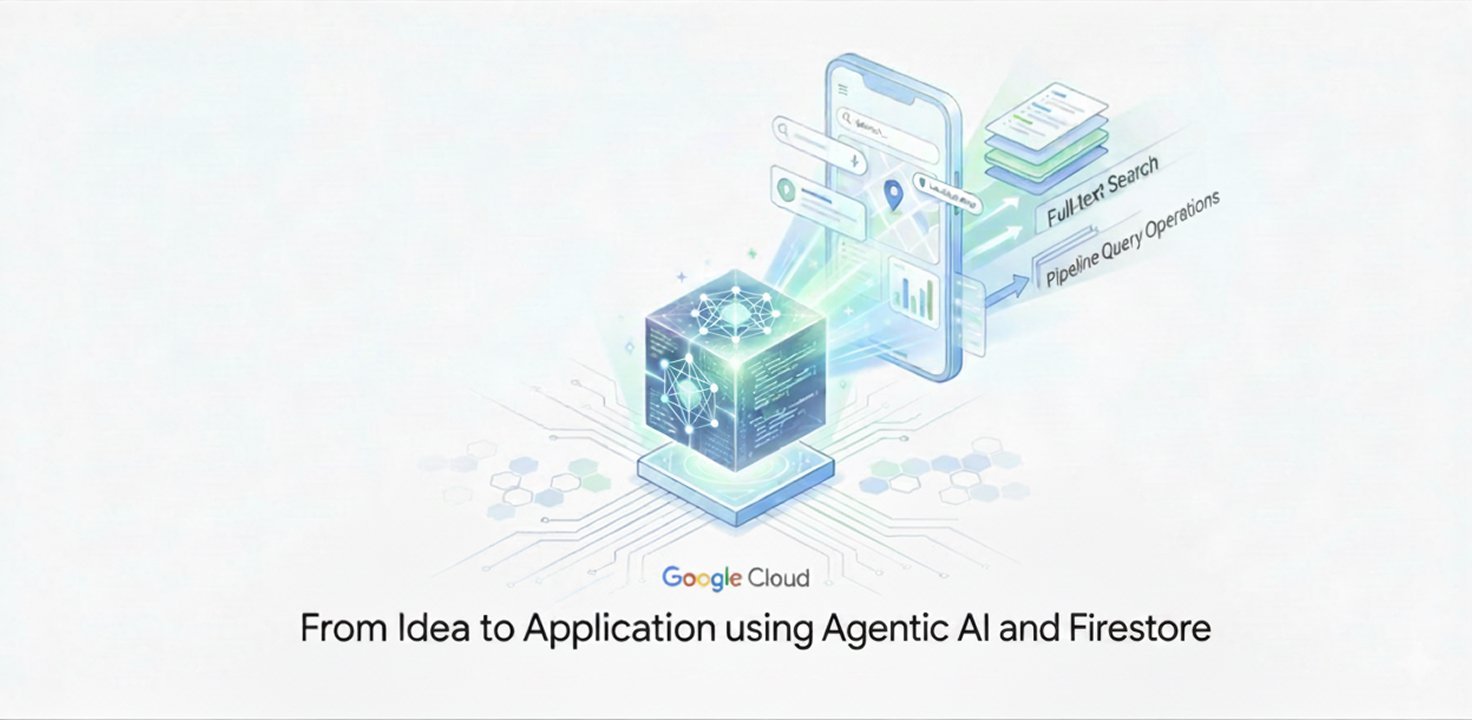
In the era of AI agents, the distance between a big idea and a working application has never been shorter. As we lean more heavily on agents to help us build applications, a critical question remains: can your database infrastructure keep up?
With its virtually limitless scalability and high availability, Firestore, Google Cloud’s fully managed document database, is a great fit for emerging agentic applications. And at Google Cloud Next ‘26, we leveled up Firestore for AI-driven apps even further, with:
-
Tighter agentic AI integrations: New native integrations with AI Studio and third-party coding agents mean your LLMs and database now speak the same language.
-
Full-text search and expressive queries: Differentiated search capabilities and pipeline operations mean agents and users are able to find exactly what they need within your data.
-
Enhanced MongoDB compatibility: Now it’s easier than ever to bring existing MongoDB workloads into the Firestore ecosystem.
In this blog, we’ll take a closer look at our announcements from Next ‘26. But first, here’s a Firestore refresher.
The case for Firestore
Whether you’re an enterprise leader looking to empower your workforce to build their own productivity tools, or a founder sketching out the next big thing on a napkin, you need to be able to prototype at the speed of thought, pivot the moment you get user feedback, and do it all without breaking the bank — or the database.
When it comes to selecting a database, you need to worry about:
-
Scaling: Can the database survive a viral traffic spike?
-
Budget efficiency: Does the solution scale to zero during inactivity to reduce your costs?
-
Iteration speed: Will frequent tweaks in your agent prompts be slowed by expensive database schema migrations to fulfill those requests?
We designed Firestore to address these exact concerns. Firestore has always been an easy way to achieve rapid, automatic, elastic database scaling, with its serverless architecture that also provides sub-second provisioning. Meanwhile, Firestore’s document model makes it easy and fast to iterate on your data structures — no breaking schema changes, no downtime, just flow.
At the same time, accelerating development velocity shouldn’t mean compromising on enterprise governance. Firestore offers an industry-leading 99.999% SLA and ACID-compliant transactions, all while benefiting from the rigorous security and privacy oversight, fundamentally inherent to Google Cloud.
Companies like FlutterFlow are already reaping the benefits.
“As an AI-native company dedicated to democratizing web and mobile development, Firestore has served as the foundational database powering FlutterFlow as we scaled from zero to over 3 million users across more than 150 countries. Over the past five years, we have experienced zero outages while serving more than 750 billion reads and 75 billion writes. We are true believers in Firestore.” – Abel Mengistu, CEO and Co-founder, FlutterFlow
With that background, here’s what’s new in Firestore from Next ‘26.
1. Accelerating application development through agentic AI integrations
We embedded Firestore directly into the AI creative process. Through new native integrations with AI Studio, developers can now build and provision fully functional full-stack applications with an integrated Firestore database and added authentication from a single natural language prompt. This integration is driving incredible momentum on Firestore, bringing the overall Firestore developer base to 750,000 monthly active developers and over 10M hosted databases.