The complexity of modern telecommunications is exploding. Communication Service Providers (CSPs) are no longer managing static, isolated networks; they are orchestrating massive, multi-layer ecosystems that span 5G radio access, transport fiber, edge compute, and centralized cloud cores.
To manage this complexity, CSPs are building autonomous networks — self-managing telecommunications networks that use AI, machine learning, and closed-loop automation to self-configure, self-optimize, self-heal, and self-secure with minimal human intervention. According to Google Cloud’s autonomous networks framework, a critical building block for an autonomous network is a high-fidelity, real-time digital twin. You can then use advanced graph machine learning (GraphML) such as graph neural networks (GNNs) on the network digital twin to analyze, predict and proactively remediate potential problems on the live network.
This approach is not new at Google. It is the same architectural philosophy we use to manage our planet-scale network and power complex systems like Waymo’s self-driving car technology. GraphML enables this by understanding the geometry of the world around it, and the relationships of the objects in it, enabling it to make safe, autonomous decisions. Today, through a strategic collaboration with GraphML-based AIOPs solution provider NetAI, we’re bringing this same relationship-aware intelligence to the telecom industry. At Mobile World Congress (MWC) 2026, Spanish telecommunications provider MasOrange is showcasing a Proof of Concept (PoC) that explores this concept as a way to drive fully managed AIOps.
The digital twin foundation: Modeling your network
The first step in building an autonomous network is to move from a static inventory to a dynamic digital twin.
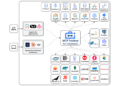
Traditional operational models rely on fragmented data lakes, where topology is often just another table. In our framework, we use Spanner Graph to build a dynamic digital twin of the network, explicitly modeling live network relations and topology. This twin captures billions of dependencies — mapping exactly how a specific optical transponder supports a particular IP interface, for example, which in turn supports a customer’s 5G slice.
This graph structure is not just for visualization; it provides the topological context as input for advanced GNN-based AI models.
GNNs vs. traditional ML
For years, the industry applied traditional machine learning (ML) to network operations, often with mixed results. To understand why GNNs are the superior choice for autonomous networks, let’s look at how they treat data compared to traditional methods.
Standard ML algorithms, such as random forests and basic deep learning, generally interpret network data as simplified, flat vectors or disconnected time-series sequences. This perspective results in models that:
-
Are topology-blind: Standard models do not inherently understand network topology. They don’t “know” that Router A is physically connected to Switch B, meaning they miss the one of the most important features of a network failure: propagation.
-
Are symptom-based: Traditional ML models excel at detecting that a metric has spiked (anomaly detection) but struggle to understand why.
-
Detect correlation, not causality: These models rely on statistical correlation. If CPU usage spikes at the same time as packet loss, they assume a link. However, in a complex network, correlation is often coincidental or a downstream symptom of a distant failure.
GNNs are fundamentally different because they are structure-aware. This enables:
-
Native topology processing: GNNs ingest the network graph directly. They don’t just look at the data on the nodes; they process the connections between them.
-
Deterministic reasoning: Instead of guessing based on statistics, GNNs use message passing. If a fiber cut occurs, the model mathematically propagates that “fault signal” along the known physical paths in the digital twin to predict exactly which upper-layer services will fail.
-
Precise anomaly detection: By understanding relationships between neighbors, a GNN can distinguish between a local anomaly (one chaotic router) and a structural anomaly (a sub-graph failure), drastically reducing false positives.