
The telecommunications industry has reached a critical tipping point. Traditional, on-premises-heavy data center models are struggling under the weight of escalating infrastructure costs and an under utilization due to availability and compliance requirements. But the AI era demands exponential scale and beyond-nines reliability. The question for operators is no longer if they should modernize, but which architectural path will help them do that fastest.
Modernization isn’t a “rip and replace” event; it’s a strategic choice. Today, we’re showcasing how Google Kubernetes Engine (GKE) can serve as a high-performance foundation for two versatile deployment strategies: cloud-centric evolution and strategic hybrid modernization.
The two paths to network modernization
Every operator has a unique appetite for risk, regulatory landscape, and investment base, with some prioritizing agility, and others emphasizing the need for local control. You can use GKE to support both approaches:
1. Cloud- centric modernization: Agility at scale
This path is for operators looking to fully harness the cloud’s elasticity. Whether you’re migrating your own containerized network functions (CNFs) or building a cloud-native service like Ericsson-on-Demand, the goal is the same: move the heavy lifting to Google Cloud.
-
The benefit: By running mission-critical workloads like Voice Core or Policy Control Functions on Google’s global fiber backbone, operators can scale instantly for peak events and move toward “zero-human-touch” operations.
-
The economics: Transition from heavy upfront CAPEX to a “pay-as-you-grow” model. You no longer need to over-provision hardware that sits idle; the cloud absorbs the bursts for you.
-
Time to market: Accelerate time to market for new services like fixed wireless access, IoT and private 5G.
2. Strategic hybrid modernization: Cloud agility, local control
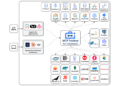
For many telcos, a hybrid approach offers a better balance. Here, operators can selectively move agile control plane components and data analytics to the cloud while keeping latency-sensitive user-plane functions on premises or at the edge.
-
The benefit: Optimize for ultra-low latency and meet strict data sovereignty requirements by keeping data plane traffic local, while still gaining the AI-driven insights and orchestration power of the cloud.
-
The versatility: Using GKE, you can run your control plane workloads in the cloud and data plane services directly in your own data centers or at the network edge, enjoying a unified operational model across your environments.
Engineering the “telco-grade” foundation
Today, we are proud to showcase how GKE has evolved into the industry’s most specialized platform for containerized network functions (CNFs), backed by massive momentum from operators and equipment vendor partners.