
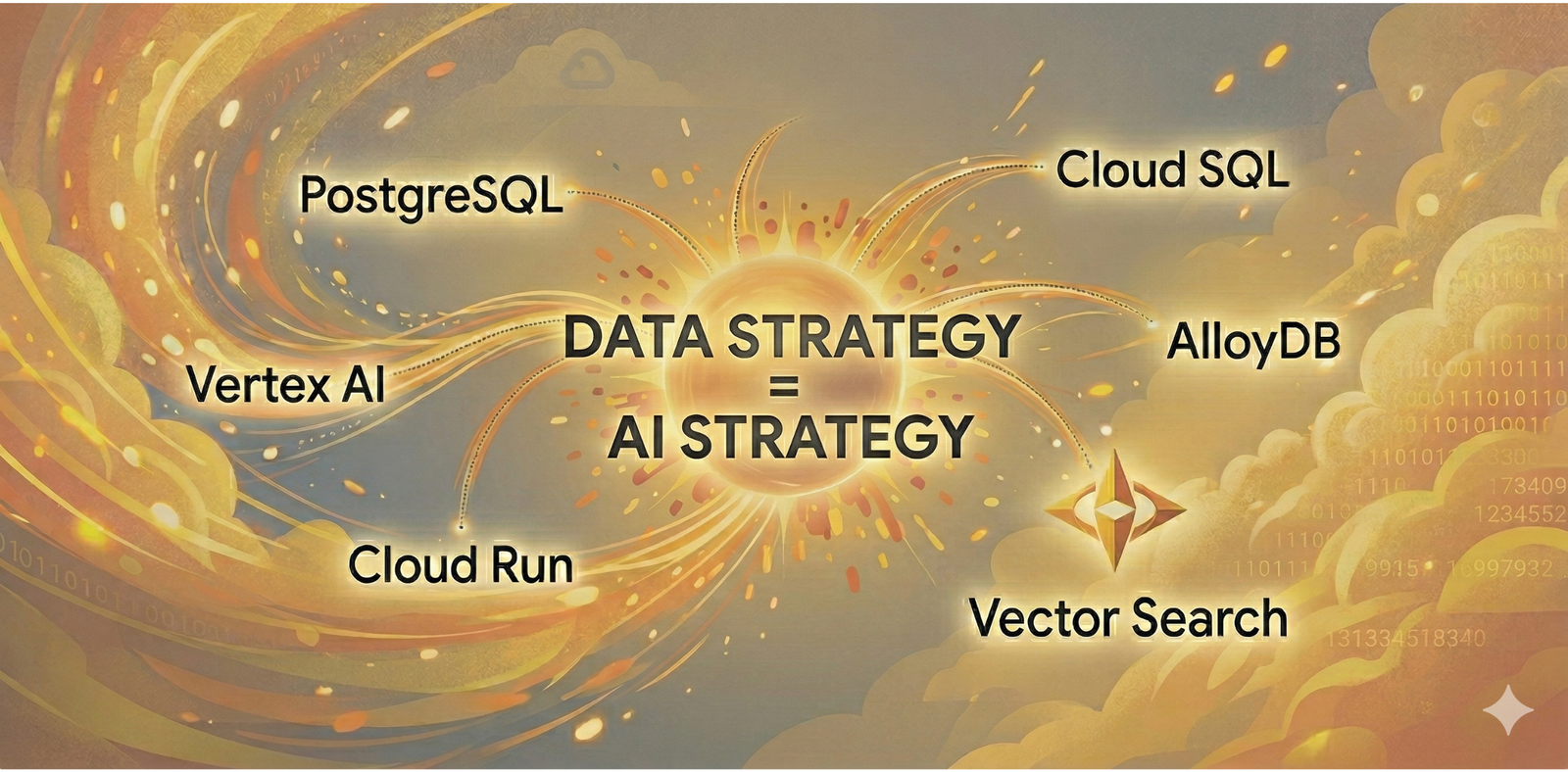
Your agent is only as good as your data grounding. If your data is messy, your agent will be highly confident but possibly still hallucinating. In 2026, your Data Strategy and your AI Strategy are now the same thing. You cannot have one without the other.
This series, “Data Strategy = AI Strategy,” focuses on the various aspects of this strategy and it can help you architect workflows that are more deterministic while still building autonomous agents. This post is just the first episode in which we focus on data and AI architecture convergence.
The industry is reaching a critical inflection point. Although 2024 and 2025 were defined by the “API era”—where developers learned to integrate LLMs through apps & endpoints—2026 demands a shift towards enterprise architecture. To build production-ready applications, developers must transition from writing prompts to designing intelligent end-to-end stacks.
The challenge isn’t just about the AI model that you use; it’s about the infrastructure around it. For an application to be enterprise-grade, it must meet the requirements of three critical pillars: speed, scale, and security. We focus on these pillars in this article: moving away from building agents that are focused on AI adoption to architecting agents that are grounded in well-strategized context. More specifically, this blog and the linked codelabs provide a hands-on learning path that shows you how to build an architecture by using Google’s data cloud. This approach uses relational databases that are easily 100% PostgreSQL compatible.
The Strategic Pivot: The Database as the Context Engine
In a modern AI stack, the database is no longer just a storage layer; it has become the context engine. Our strategy centers on using fully PostgreSQL-compatible services like AlloyDB for PostgreSQL and Cloud SQL to eliminate the primary bottlenecks of AI in production: latency, AI capabilities, and retrieval accuracy.
To enable this transition from developer to architect, the learning path focuses on eliminating infrastructure friction and prioritizing high-level architectural design.
1. Eliminating the Infrastructure Tax
Historically, the transition from local prototyping to cloud-scale deployment was hindered by the infrastructure tax—the hours spent on configuring clusters, instances, and VPC network peering. By introducing automated setup utilities, we let developers bypass these configuration hurdles.
The result is a shift in focus: instead of managing infrastructure, developers can spend their time on designing secure data flows and high-throughput vector pipelines. In our recent instructor-led Code Vipassana sessions, each participating developer saved over an hour of time in each lab because of this shift. This approach effectively accelerates the path to production.
2. Building for Scale: One Million Vectors, Zero Loops
To build enterprise architecture, you need to move beyond small-scale demos. We focus on batch processing for embeddings to expedite vector search processes. AlloyDB can generate embeddings at scale directly within the database layer. By using this capability, we can eliminate the latency of traditional loops, which allows us to do real-time analytics on massive datasets.
3. Sovereign Intelligence and Row-Level Security (RLS)
Security in AI is more than only a firewall; it’s about data governance. We emphasize the use of row-level security (RLS) to help ensure that AI agents can access only the specific data they’re authorized to see. This private vault architecture is essential for regulated industries where data isolation is a non-negotiable requirement. Imagine your user talking to your agent and learning about another user or a benchmark. Baking the data level security into the database is not an option anymore. We cannot rely on agents to make the call on who should be informed of what.
The Architectural Learning Path
We have curated a series of hands-on technical labs that form a complete narrative of enterprise AI development. Each lab represents a specific layer of the intelligent stack
Most of the labs use AlloyDB. However, the momentum of this architectural strategy has also extended to the Cloud SQL ecosystem. Our learning path includes a couple of alternative labs for Cloud SQL for PostgreSQL users.
Our recommended learning path includes the following core architectural labs:
-
This lab serves as the entry point for architects, by demonstrating how to provision a high-performance AlloyDB cluster with the required VPC and network settings in minutes. It focuses on the day 0 operations that help to ensure a secure and scalable foundation for all subsequent AI logic.
-
Connect your app to AlloyDB data and deploy on Cloud Run (or Connect to Cloud SQL and deploy on Cloud Run)
Moving into deployment, this lab explores the architecture of serverless applications. Developers learn how to connect Cloud Run services to AlloyDB (or Cloud SQL), with a focus on using managed identities and connection strings to improve security. This approach helps ensure that the application layer is as robust as the data layer.
-
Build a Real-Time Surplus Engine: Gemini 3 Flash & AlloyDB (or Gemini 3 Flash & Cloud SQL)
This lab addresses the pillar for speed by building an end-to-end, data-driven AI app. It demonstrates how to use the high-efficiency Gemini 3 Flash model to process streaming data and generate real-time insights. This approach creates a responsive feedback loop between the database and the end user.
-
One Million Vectors, Zero Loops: Scale with AlloyDB
Focused on scale, this lab dives deeply into the vector search process. Architects learn how to implement batch processing for embeddings directly within the database. This approach bypasses application-layer bottlenecks, which enables the ingestion and search of millions of vectors with enterprise-grade performance.
-
The Private Vault: Zero Trust Intelligence with RLS
The final piece of the architectural puzzle focuses on improved security. This lab guides developers through building zero trust agents. By implementing RLS in PostgreSQL, developers can help ensure that their AI agents respect user-specific data boundaries. This approach provides a blueprint for compliant AI systems with enhanced security.
Designing the Future
By removing the friction from infrastructure and focusing on the core principles of speed, scale, and security, we can empower a new generation of AI architects. This strategic shift can help ensure that the applications built today are ready for the production demands of tomorrow.
To join our upcoming instructor-led, hands-on sessions and begin your transformation from developer to architect, sign up for Code Vipassana.