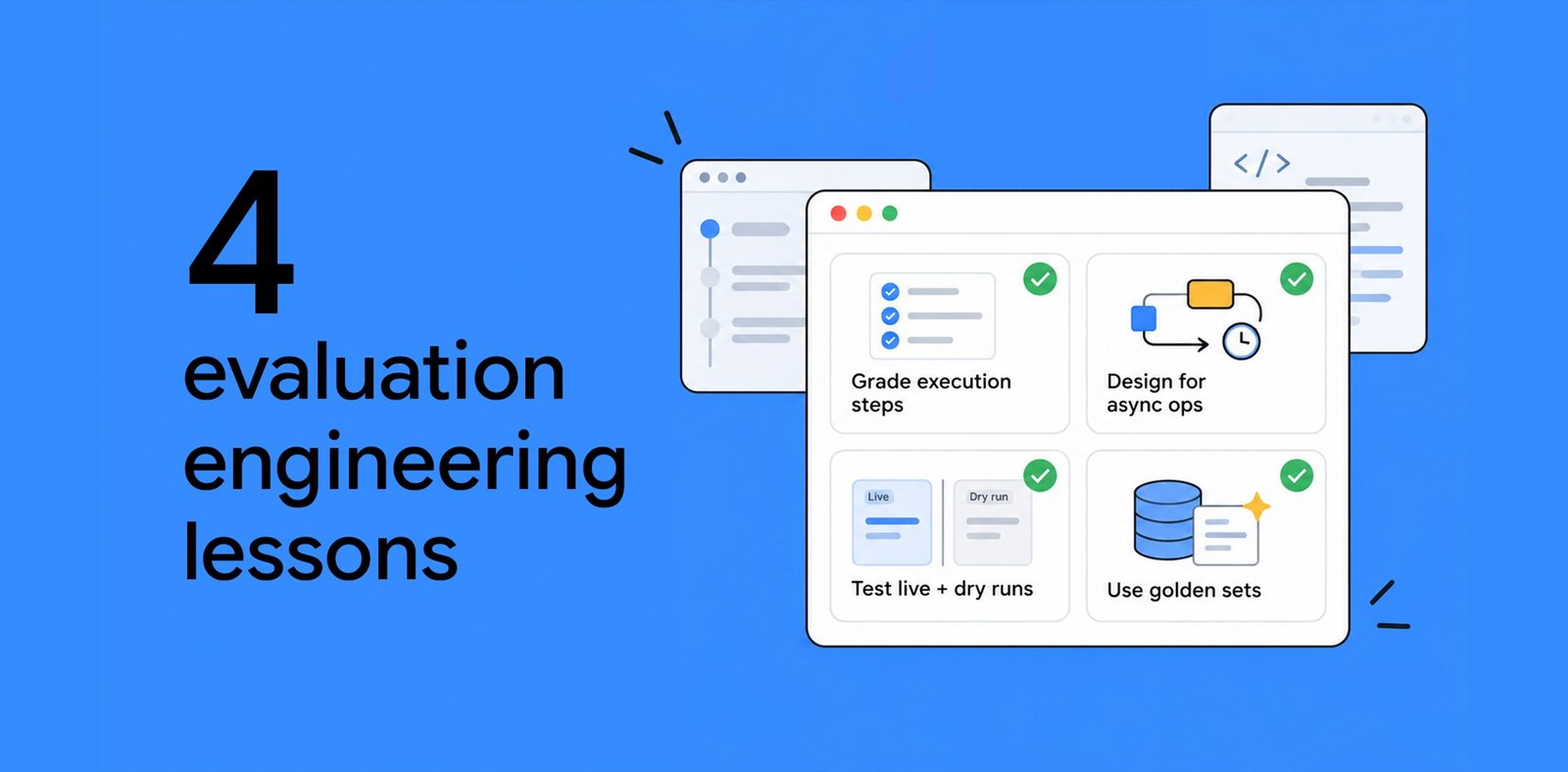
For example, on one of our onboarding prompts, a live run was blocked immediately on a project list call. The plan-only run sailed right through and produced an 8,000-character plan that completely ignored organization policies, admin approvals, and governance. The live run masked a major cognitive flaw that the plan-only run exposed in seconds.
Takeaway: Run live and plan-only evaluations side by side. Live runs test actual execution and safety restraint; plan-only runs expose the model’s raw reasoning and routing without getting tripped up by permission errors.
4. Use “golden sets” as durable baselines
Frontier model architectures change every few months, agent harnesses improve, and plugin manifest standards will inevitably evolve. When building the Google Cloud Developer plugin, we treated evaluations as continuous integration testing for these non-deterministic environments. That means we stress-tested the composite stack, including the harness, the live model, and the tools running together on realistic tasks.
Instead of guessing from the final text output, this approach captures the whole trajectory: what the agent thought, what commands it actually ran, and whether it solved the problem without breaking anything. Then you score that run against golden sets curated by real human experts who know what the ideal path looks like.
Takeaway: Build golden sets based on what the entire system should actually do in the wild, including your harness, model, and plugins. Models change, but those baseline runs are your safety net.
Reminder: Use evaluation suites over “one-shot” demos
A common mistake I see among engineers is what I like to call the one-shot demo. This is when someone feeds a prompt into a LLM, watches it build a complete 3D game or solves a Rubik’s cube in a single pass and calls it an eval. But in reality, this is just a vanity metric.
To do quality work with AI, I truly believe that you need evaluation suites. Without evaluations, teams are like literally running into a dark cave blind. Engineering an enterprise-grade agent means testing the system’s ability to handle multi-step interactions, manage permissions, and avoid destructive outcomes like accidentally deleting a project because you asked it to “find opportunities to save costs.”
Where to go from here
Building an agent plugin or MCP server is the beginning. Shipping something you can actually trust with real cloud infrastructure requires significantly more work in evaluations to ensure it’s doing what you expect it to do. At the end of the day, the only thing that outlasts model churn is a stress-tested eval suite. Check out the Google Cloud Developer plugin documentation or explore this codelab to get started with the plugin in Antigravity.