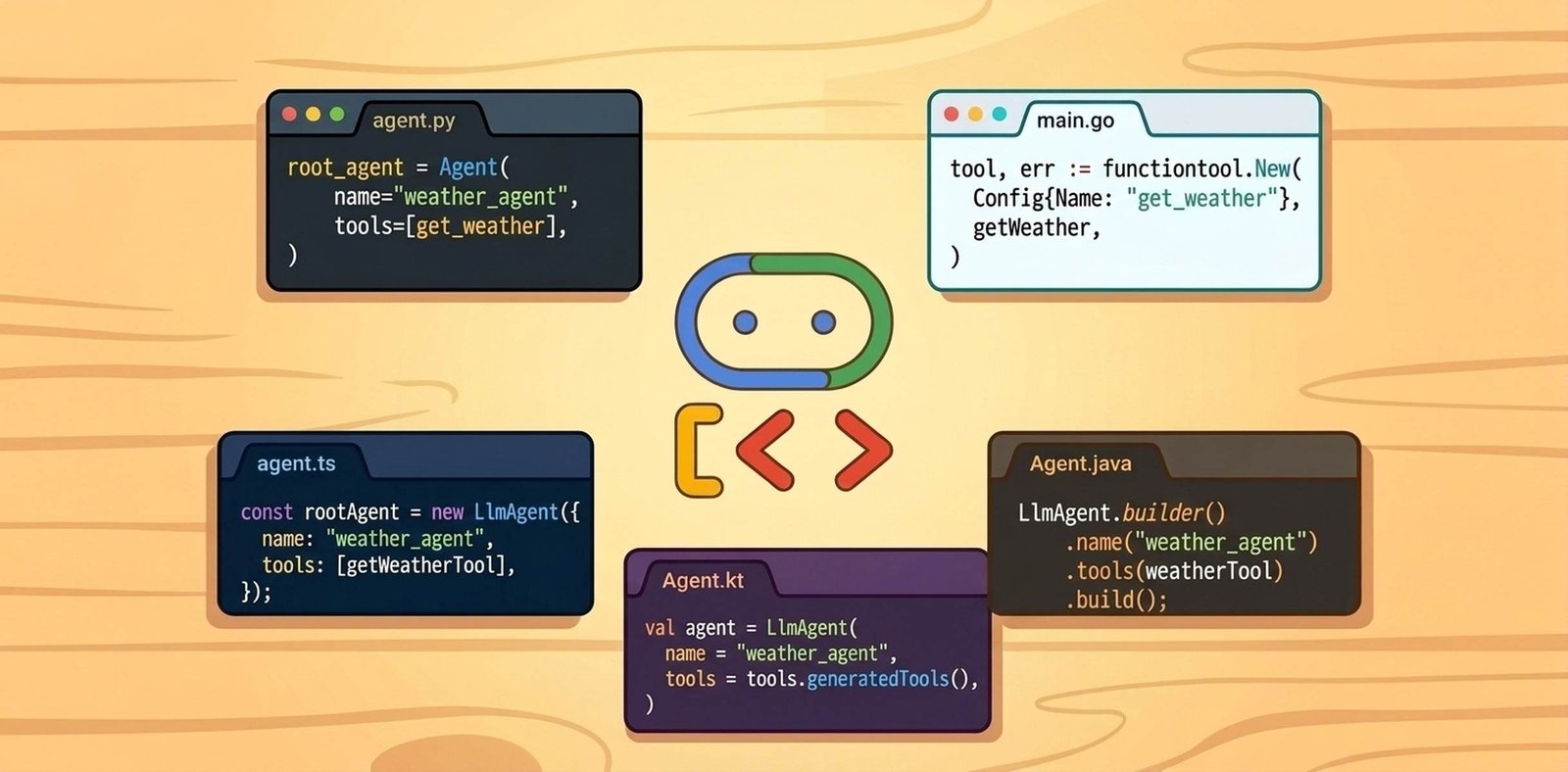
When we talk about agents, that doesn’t necessarily mean we’re talking about Python. In today’s modern ecosystem, an agent might run as a high-concurrency Go microservice on Cloud Run, or live inside a browser tab calling Chrome’s on-device model. Yet many agent frameworks assume a Python-only stack. That assumption forces teams to either spin up a Python service just for their agent workloads, or to build agent orchestration logic from scratch in their own language.
Google’s Agent Development Kit (ADK) removes that trade-off with coverage for Python, Go, TypeScript, Java, and Kotlin. Each version of the ADK is built from the ground up for its own runtime and type system, while sharing a unified architecture with interoperability through open protocols.
A shared foundation
Picking a language doesn’t lock in your architecture: all five support the same open protocols. ADK includes a Model Context Protocol client in every language, so a custom tool exposed as an MCP server can be called from any of them immediately.
For multi-agent systems, ADK supports the Agent2Agent (A2A) protocol, allowing an agent to communicate with a remote agent over HTTP. Through A2A, agents written in different languages or frameworks are interoperable.
Starting agent-first
To get started, run the one-time setup command to check your Google Cloud authentication, install the CLI, and then set up first-party ADK skills in coding agents like Antigravity, Claude Code, or Codex: