
Moving Large Language Models (LLMs) from experimental prototypes into enterprise production exposes a critical truth: your infrastructure dictates both your performance ceilings and your unit economics. Standard hardware benchmarks often ignore a fundamental reality—not all LLM requests stress the silicon in the same way.
In this post, we dive into a comprehensive benchmarking exercise comparing Gemma 3 12B and Gemma 3 27B on Google Cloud TPU v6e to answer a crucial architectural question: How does TPU infrastructure actually perform when tasked with structurally distinct workloads at scale?
Key Findings and Suggestions
Before diving into the methodology, here are the critical takeaways for architects deploying Gemma 3 on TPU v6e:
The Generation Performance Wall
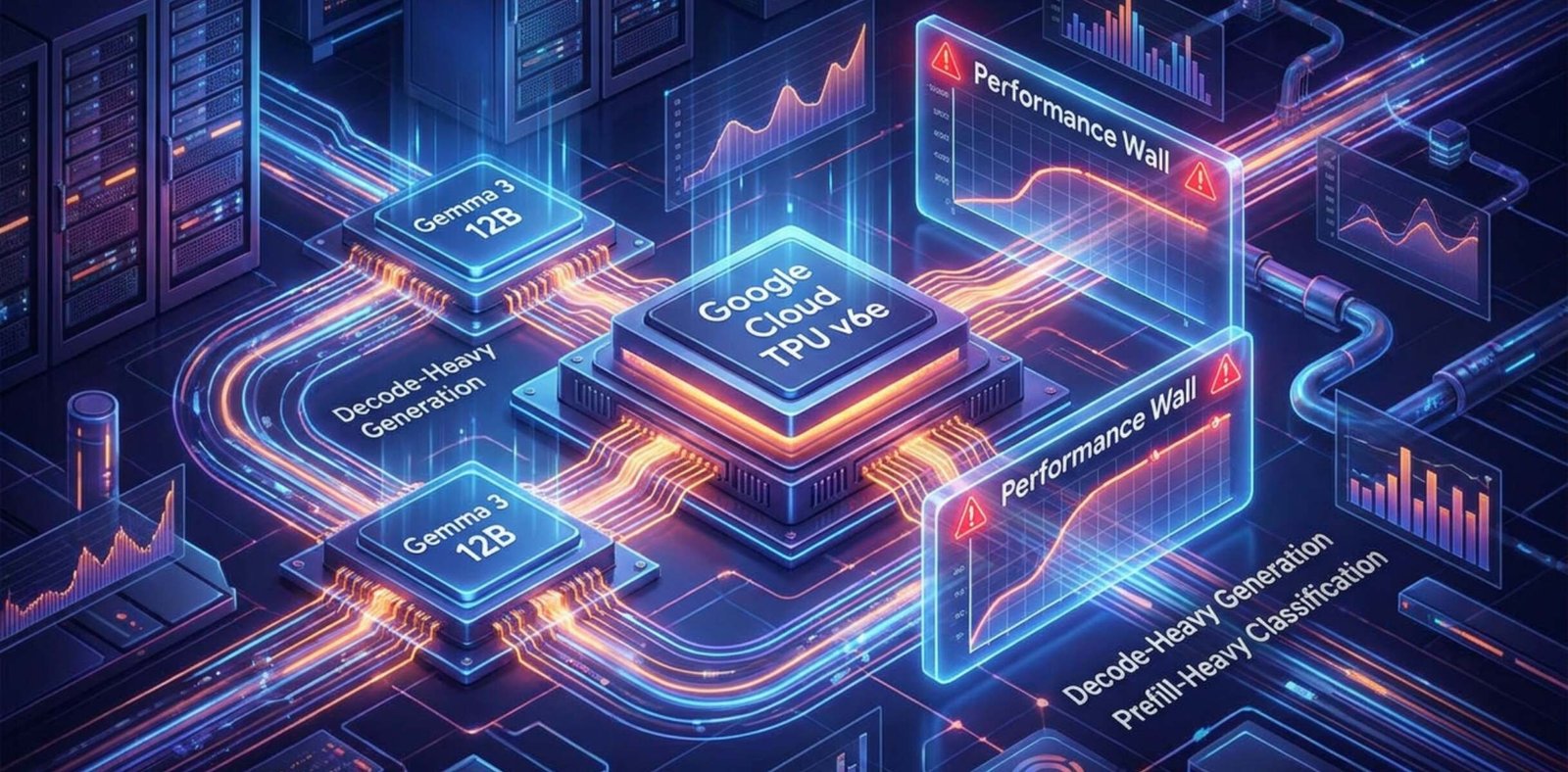
For decode-heavy generation tasks, the Gemma 3 27B model hits a strict performance wall past 64 concurrent users, plateauing at a 4.12x normalized throughput multiplier at 128 users. In contrast, the 12B model scales up to an 8.19x multiplier.
Suggestion: If your workload requires high-concurrency generation, downsize to the 12B model, or set strict pod-autoscaling limits capping concurrent requests at 64 per replica for the 27B model.
The Classification Parity
For prefill-heavy classification tasks, model parameter size matters significantly less. Both the 12B and 27B models achieve similar peak scaling (around 6.0x to 6.4x normalized throughput at 128 users) without saturating the TPUs.
Suggestion: You can safely deploy larger, more capable models for summarization or classification workflows without paying a throughput penalty. The average –max-num-seqs or –max-model-len should be kept judiciously based on the average user load and average tokens per request, without which there might be request drops.
Designing Around the Wall
Hardware saturation manifests as severe latency spikes and silent request dropouts. To mitigate this, do not rely on standard CPU/Memory scaling triggers. Instead, scale based on End-to-End (E2E) latency metrics, and implement aggressive vLLM bucket padding optimizations (VLLM_TPU_BUCKET_PADDING_GAP) to conserve memory.
The Architecture Setup
The inference stack can be divided into three core pillars:
1. Infrastructure: GKE & TPU
The foundation of our deployment is a Google Kubernetes Engine (GKE) Autopilot cluster. Connected to this is a single-host TPU v6e node pool configured with a 2×2 chip topology.
2. Software & Tools: vllm
For the serving framework, we leveraged vllm via vllm-project/tpu-inference.
3. Models: Gemma 3 12B and 27B
We evaluated two highly capable open-weights models: Gemma 3 12B and Gemma 3 27B. These models were accessed via HuggingFace.
The Workloads: Classification vs. Generation
Not all LLM requests stress the system equally. We benchmarked two distinct scenarios: Classification and Generation, across 16, 32, 64, and 128 concurrent users:
- Classification (High Input, Low Output): This use case mimics an e-commerce compliance task. The prompt includes large blocks of product rules, item descriptions, and OCR-extracted text. The output is exceptionally small—typically just classifying an item as “Allow” or “Prohibit”. Input Sequence Length (ISL) is ~4,000 tokens and Output Sequence Length (OSL) is ~10 tokens.
- Generation (Low/Medium Input, High Output): This use case mimics long-form text generation. The prompt requests a detailed, analytical policy brief on the future of AI in the labor market. The model spends the majority of its time decoding and streaming out hundreds of tokens. Input Sequence Length (ISL) is 500 tokens and Output Sequence Length (OSL) is ~1,000 tokens.
Results and Observations
We measured metrics like Throughput (requests/sec), End-to-End Latency and the results provided some fascinating insights into how parameter size and hardware bandwidth interact. To ensure architectural consistency, every benchmark was executed using the vllm-project/tpu-inference hardware plugin, leveraging a standardized global serving configuration of max-model-len=128000, max-num-batched-tokens=8192, and max-num-seqs=512.
Generation Scaling Divergence
In Generation tasks, both models perform similarly up to 64 concurrent users. However, at 128 concurrent users, the Gemma 3 12B model shows significantly better scaling, achieving an 8.19x normalized throughput multiplier compared to a 4.12x plateau for the Gemma 3 27B model (normalized against the Gemma 3 12B baseline at 16 users). This suggests that the larger 27B model hits memory or compute limits much earlier under high generation loads.
| Concurrent Users | Gemma 3 12B Throughput (req/s) | Gemma 3 27B Throughput (req/s) |
| 16 users | 1.00 x | 1.05 x |
| 32 users | 1.98 x | 1.97 x |
| 64 users | 2.96 x | 4.00 x |
| 128 users | 8.19 x | 4.12 x |