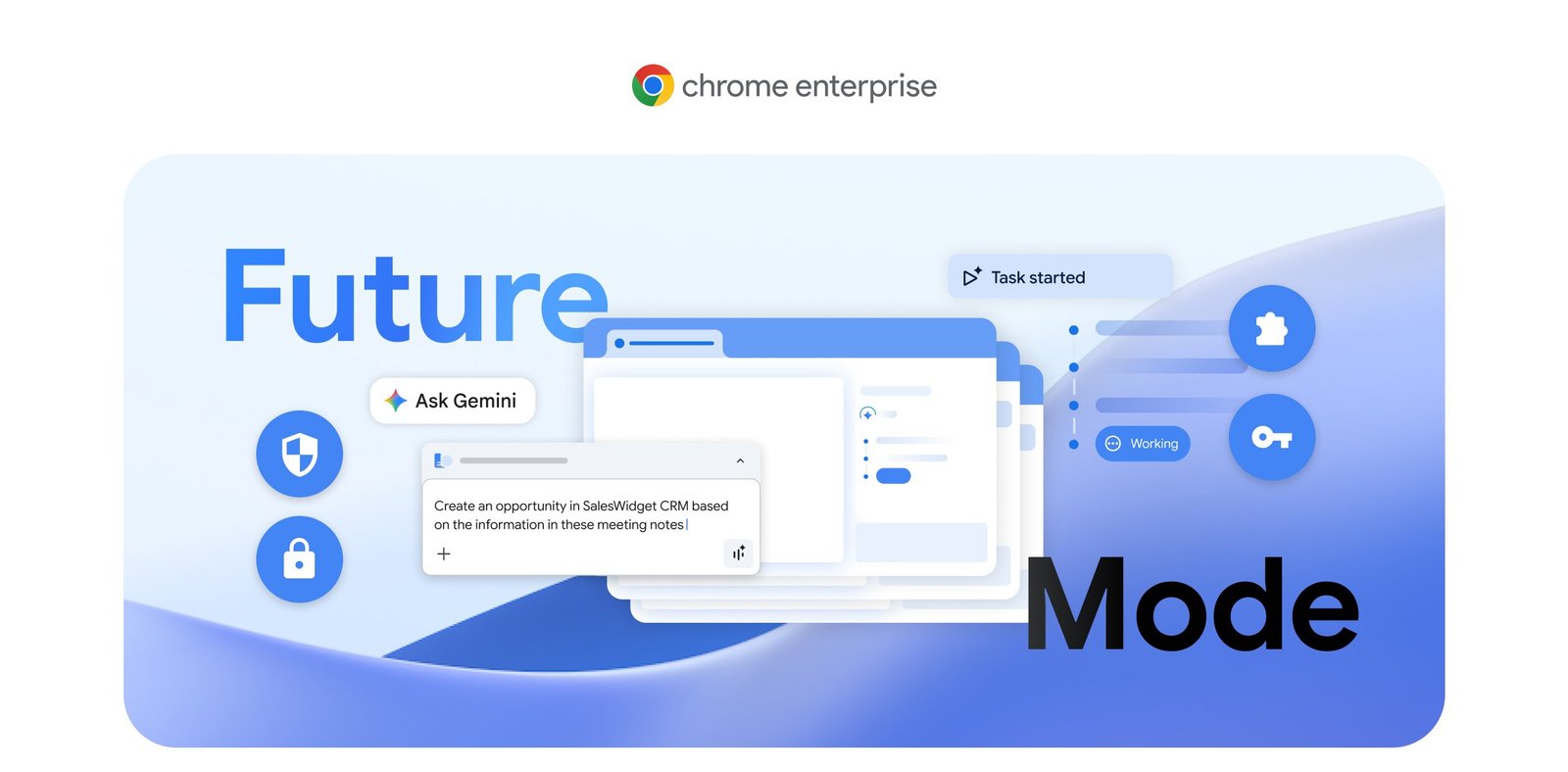
Editor’s Note: Our Future Mode series will give businesses insight into how Chrome Enterprise is approaching AI in the browser. Stay tuned for more blogs in this series.
Future Mode Part 2: The foundation for securing agentic browsing
Today, autonomous AI agents aren’t just drafting emails. They’re navigating SaaS applications, synthesizing data across multiple tabs, and completing multi-step tasks on our behalf. Because the majority of enterprise work continues to happen on the web, the browser has naturally become a primary operating ground for these autonomous workflows.
But this raises a critical mandate for IT leaders: as the line between human action and automated execution blurs, organizations need robust data protections in place for both users and agents. When an AI agent acts dynamically on an employee’s behalf, both the user’s identity and enterprise data must be secured. At Google, when we think about efficient workflows, we see the browser as one of the easiest and safest places for employees and agents to collaborate. In this blog we’ll take a look at how Chrome Enterprise is evolving its security for the agentic era.
The browser advantage
The browser is uniquely positioned to underpin this next wave of productivity workflows because it holds the context of an employee’s workday. Employees signed into Chrome are already getting the access and policy requirements set by their organization. As employees use task automation capabilities like auto browse, Chrome understands the shared tabs, open documents, and the SaaS applications the employee is currently using. By anchoring employees’ agentic workflows inside the browser, they benefit from real-time situational awareness and their corporate identity.
Let’s look at some examples. An agent can source top talent for recruiters by scanning public profiles on professional networking sites and automatically creating candidate files in their web-based Applicant Tracking System. Finance and operations teams can offload the tedious “portal hopping” required for monthly vendor management by having a browser-based agent securely log into multiple billing platforms, retrieve and reconcile PDF invoices.
Enterprise-grade controls with Chrome Enterprise
Empowering employees with AI agents means balancing security and automation. As an agent navigates between corporate CRMs, internal cloud docs, and public web apps to synthesize information, it creates new, complex vectors for potential data exposure.
Chrome Enterprise Premium brings advanced Data Loss Prevention (DLP) directly into the browser workspace so IT and security teams can enforce strict data governance on agentic behaviors in the same way they are enforced on risky user actions.
- Chrome Enterprise Premium inspects agentic data flows in real time across multiple defense layers. While built-in DLP policies block unauthorized attempts to transfer sensitive IP, PII, or financial data to public LLMs, comprehensive extension controls also let organizations manage permissions and highlight risk signals to prevent unauthorized DOM scraping.
- The browser extends context aware access controls from a user to their agentic activity. If an employee doesn’t have authorization to access or export specific data, their AI agents won’t either.
Continuous momentum in browser security
Chrome is doing a variety of things to make secure agentic collaboration possible, building on a long history of advancing web safety. We are actively launching capabilities to give IT leaders the visibility they need for this new era. For example, we launched analogous extension visibility earlier this year—giving organizations deep visibility into how software agents access and handle sensitive data—and we have many more enterprise guardrails in the works.
As we extend these protections to agentic browsing, we’ve designed a robust, layered architecture built on three core pillars to protect users and agents alike from emerging threats like indirect prompt injection:
- Partially inspired by Google DeepMind’s CaMeL research, the User Alignment Critic with Chrome auto browse is an isolated, high-trust system model that acts as a secure gatekeeper. It analyzes only the metadata of a proposed action to ensure it aligns with the user’s original goal. If an injection attack tries to hijack the agent, the Critic vetoes the action instantly.
- Site Isolation is the bedrock of Chrome’s security. We are extending this by architecturally limiting an agent’s playground to origins strictly relevant to the immediate task. The browser prevents a compromised agent from acting arbitrarily on unrelated, logged-in sites.
- As the agent operates, it logs its exact logic in a work log in the browser tab, allowing the employee to intercede at any moment and keeping the employee in the loop. For example, Chrome’s auto browse intentionally stops at critical junctures, like finalizing a contract, submitting a financial transaction, or executing a mass email. Chrome acts as the enforcement mechanism, requiring explicit human approval before any high-stakes action is committed. Employees also get visibility into agent’s actions via Chrome History, where background pages navigated by the agent are explicitly tagged as agent actions.
This philosophy of transparent, human-centric AI assistance is also what drives our broader ecosystem innovation, including Gemini Spark. To make the Gemini Spark experience even more powerful, we’ve just launched a new direct Chrome integration.
Our commitment to agentic security and looking forward
To ensure our defenses are ironclad, we have deployed automated machine-learning red-teaming systems to continuously test Chrome against synthetic threats. We have also expanded our Vulnerability Rewards Program (VRP) to include Chrome’s agentic capabilities, offering up to $20,000 for researchers who identify verified breaches in our agent security boundaries.
The future of productivity is about secure, seamless collaboration. By extending core browser isolation principles, launching foundational visibility controls, and bringing DLP to agentic workflows, Chrome Enterprise ensures that enterprises can embrace the next generation of AI productivity without compromising on security, visibility, or control—allowing enterprises to innovate safely.