
How do you prove the business value of generative AI to your teams?
Technology and finance leaders need to show the clear business value of AI projects to secure ongoing funding. While measuring return on investment (ROI) is a key part of validating your technical strategy, long-term success ultimately depends on building the organizational systems and culture needed to make AI work.
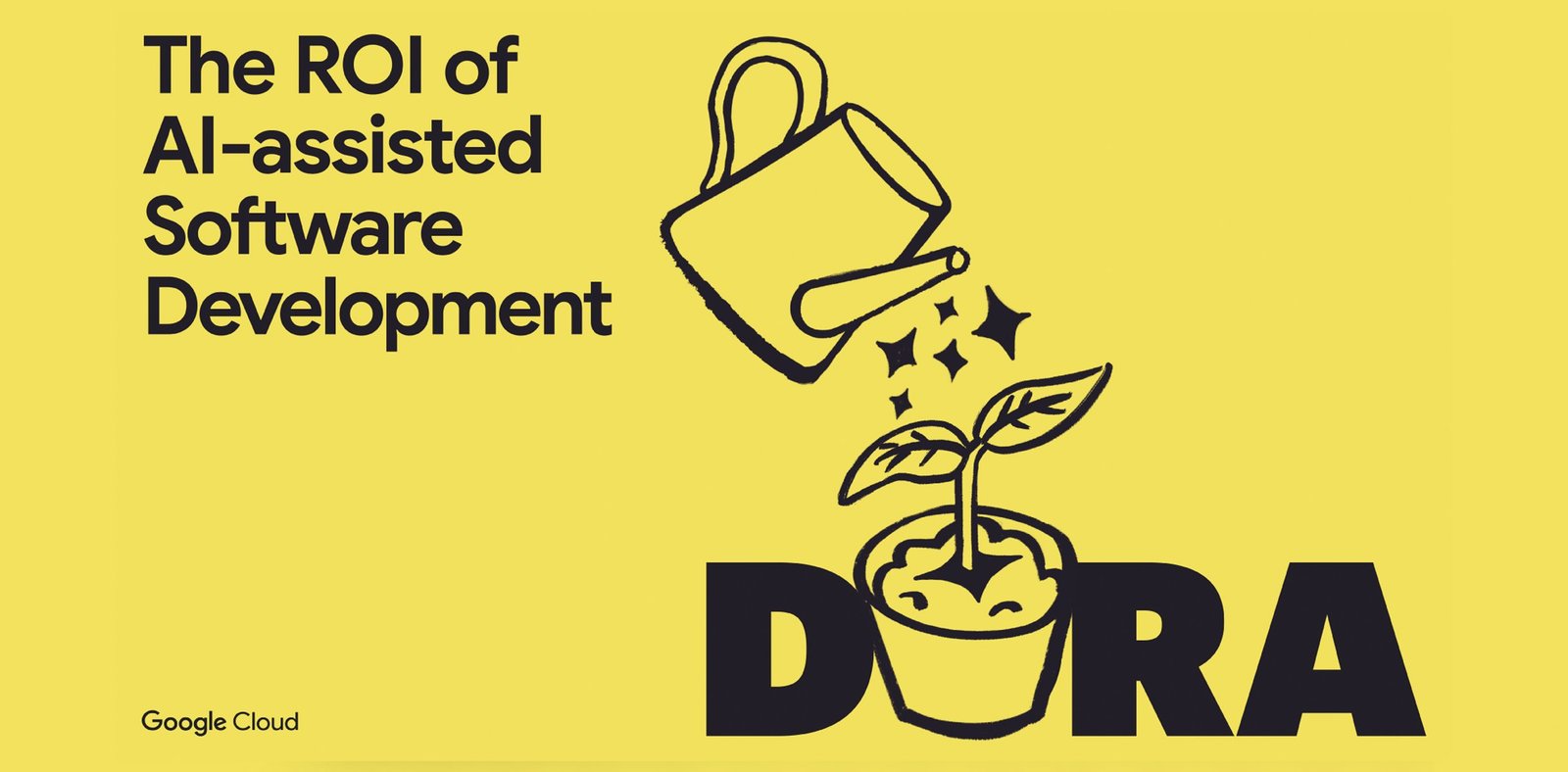
To help you evaluate the costs and business benefits of AI, we recently shared the DORA: ROI of AI-assisted software development report. This research offers a practical approach to help your team work through early adoption challenges, align engineering plans, and drive business growth.
Here are the key findings from the report, and how you can use them to support your overall technology strategy.
Insight #1: Navigating the J-curve of AI value realization
It is important to be realistic about how quickly you will see a return on your AI investments. While AI can act as a powerful amplifier for software engineering, the path to financial value is rarely a straight line. Most organizations will instead encounter a J-curve: a temporary productivity dip and period of instability associated with early adoption.
This temporary drop is a normal part of adopting new technology, rather than a sign of a failing strategy. The report points to three main reasons why this happens:
-
The learning curve: Teams require dedicated time away from regular feature delivery to adapt their daily workflows and master advanced techniques, evolving from simple prompting to building systems based on context and intent.
-
The verification tax: Because AI dramatically increases the sheer volume of code produced, developers must invest extra time rigorously reviewing generated outputs to ensure trustworthiness, prevent hallucinations, and meet internal architectural standards.
-
Pipeline adaptation: As individual developers generate code significantly faster, downstream processes like testing and change approvals often become bottlenecks and must be actively scaled to handle the increased throughput.
Budgeting for this initial learning phase is key to making the transition work. By anticipating this temporary drop in productivity, you can confidently keep your AI projects moving forward, knowing that these early challenges are an investment in your team’s long-term speed.