

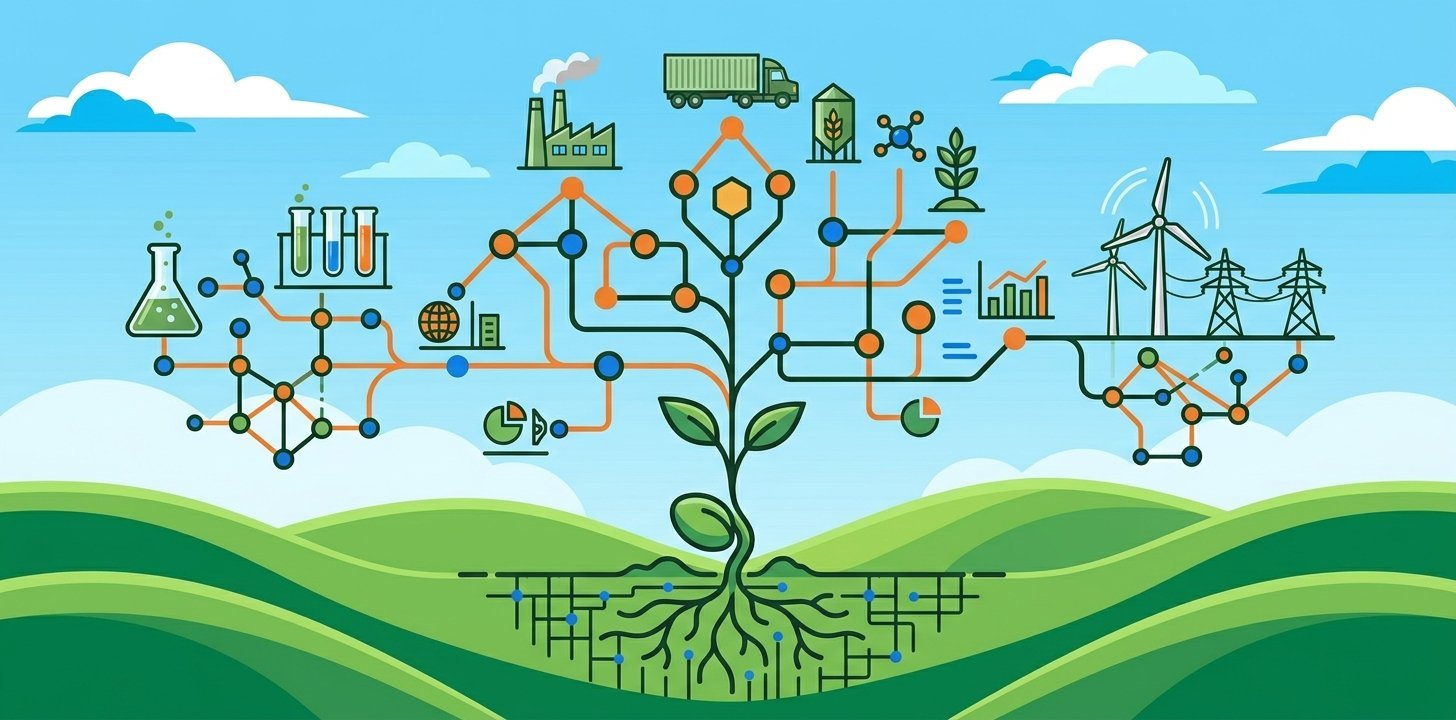
The agricultural and crop protection supply chain is one of the most intricate networks in the world. It takes up to two years to turn active ingredients into the final products farmers need, and a single change in weather or regulations can disrupt everything. Planners at BASF Agricultural Solutions navigate this reality daily across 180 production sites. To understand how local decisions ripple across their entire global network, BASF turned to AlphaEvolve on Google Cloud to build a digital twin of their supply chain.
Planning across a two-year lead time
BASF Agricultural Solutions manages a network with over 5,000 distinct value chains. Creating a single end product requires a bill of materials that can be over 30 levels deep, moving across different production sites and regions.
Currently, human planners make thousands of local decisions every day. They decide what to produce, when to produce it, and how much safety stock to hold. Because the network is so large, a planner can’t easily see how a localized decision affects the rest of the global supply chain.
This scale can lead to additional working capital and inventory and or cause production imbalances. Traditional mathematical models struggle to capture the dynamic reality of the network that planners navigate based on years of experience.
Building a foundation for decision support
AlphaEvolve is an evolutionary coding agent that generates and refines algorithms autonomously. In collaboration with Google Cloud and prognostica GmbH, BASF’s objective was not to replace human decision-making, but to establish a new model for decision support that helps planners handle the real-world complexity of the production network.
The team gave AlphaEvolve a foundational “seed” program. This initial code established a standard planning logic that translated demand forecasts into production schedules, serving as a functional baseline before introducing dynamic, network-wide coordination. From there, they fed the model three years of historical data, including inventory levels, market demand, and actual production outputs. AlphaEvolve then generated variations of the code, mutating the logic to see if it could simulate a supply chain that matched the real-world historical data.
Measuring what good looks like in initial tests
For AlphaEvolve to improve, it needed a specific goal. The evaluation function scored every new piece of generated code on one primary metric: how closely the simulated inventory levels and production decisions matched the actual historical reality recorded by BASF.
The latest AlphaEvolve runs delivered more than 80% relative improvement in accuracy compared to the initial seed model. With further adjustments, the team expects to push performance even higher — bringing the model to a level of accuracy not achieved with other approaches and making it actionable for operational use.
The results
The evolved planning logic delivered immediate, measurable improvements over the initial seed model. The final algorithm successfully mirrored the actual historical performance of the supply chain, significantly reducing the error rate compared to the initial seed.
“We had several attempts to build a digital twin for our complex supply network using deterministic models, and all of them failed,” said Dr. Goetz Krabbe, vice president for global supply chain at BASF. “By using AlphaEvolve, we cannot only map the complex network based on system data, but at the same time understand and copy the human decisions that drive our daily operations. This gives us a highly accurate and easy to maintain data driven digital twin of the entire network. Using it we can optimize our inventory levels and respond to market volatility with confidence while avoiding stockouts.”
What the evolved algorithm actually does
By running thousands of experiments, AlphaEvolve developed a clear, human-readable algorithm that explains how the BASF network truly operates. It automatically discovered factually correct, domain-specific supply chain rules that explain the observed production outputs and inventory levels for the tested product value chain:
-
Production consolidation: The algorithm learned to group production amounts together, accurately mapping how planners optimize plant time.
-
Dynamic safety stocks: It introduced safety stock parameters to handle volatile and seasonal demand patterns, helping to strictly manage capital costs while preventing out-of-stock situations.
-
Network-wide coordination: The model successfully mapped the dependencies between different production tiers, providing a clear foundation for optimizing asset utilization globally.
What’s next
The initial simulations showed that evolutionary AI can accurately model large-scale, dynamic supply chains. BASF’s objective is to create a digital twin of their entire global production network as a new foundation for simulation, decision support, scenario forecasting and optimization. This will allow the team to continuously simulate operations, identify hidden bottlenecks before they affect throughput, and optimize asset utilization across all global facilities.
This project was a collaboration between the BASF SE team including: Benjamin Priese, Michael Arlt, Debora Morgenstern and Tobias Hausen as well as Manuel Doerr and Thomas Christ from Prognostica GmbH Würzburg, and the AI for Science team at Google Cloud including (but not limited to): Kartik Sanu, Laurynas Tamulevičius, Nicolas Stroppa, Chris Page, Srikanth Soma, John Semerdjian, Skandar Hannachi, Vishal Agarwal and Anant Nawalgaria as well as Christoph Tittelbach from the Google account team and partners at Google DeepMind